


Oct 30, 2025 1:46:52 PM
“Wars are won by teachers.” — Vladimir Putin (quoted by Randi Weingarten)
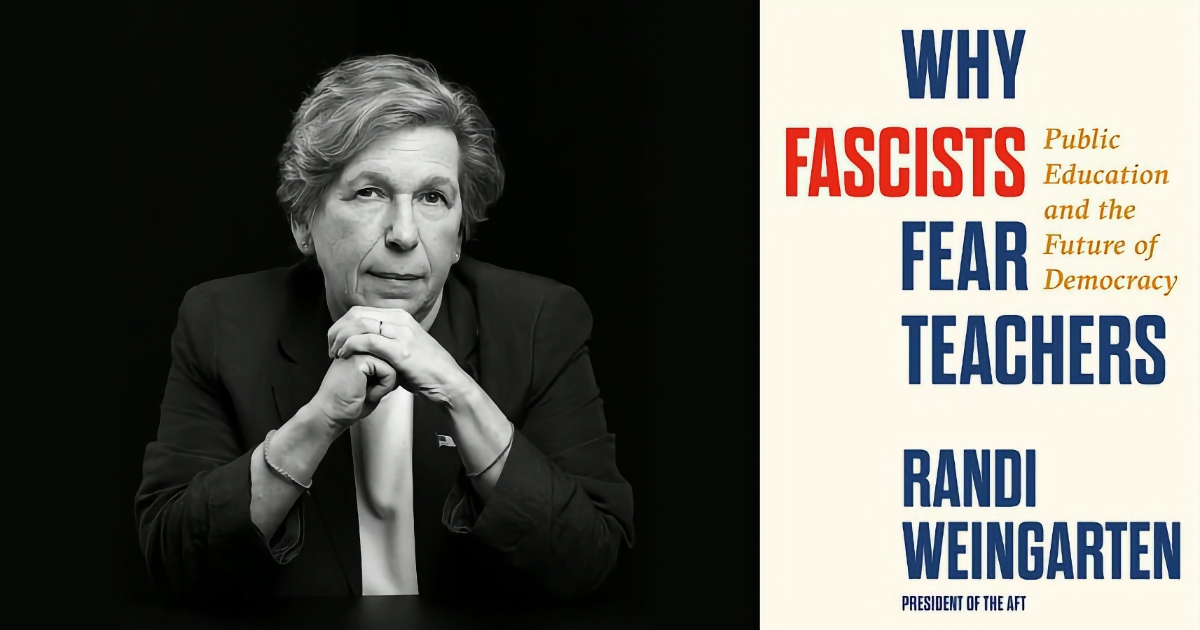
That single line could serve as the thesis for Randi Weingarten’s new book, "Why Fascists Fear Teachers." It’s less a memoir than a warning shot — a fiery, historically grounded defense of public education as democracy’s last stand.
Weingarten, president of the American Federation of Teachers (AFT), doesn’t mince words. Her book is an indictment of what she calls a decades-long “siege” against public education — an effort by far-right extremists, oligarchs, and culture-war opportunists to dismantle one of the last truly public institutions in America.
It's a big-hearted, bold-faced battle cry for defenders of educational equity.
It’s also a love letter — to teachers, to unions, and to the idea that education can still be an engine for equality and freedom.
If you’re tired of watching public schools get scapegoated and dismembered in the name of “freedom,” this book will have you fired up—and then rolling up your sleeves to do the real work.
Weingarten opens with a powerful historical vignette: Norwegian teachers resisting Nazi occupation in 1940, donning paper clips as symbols of unity against fascism. It’s a story that could feel distant — except it’s not.
The parallels to today are chillingly clear. Weingarten argues that the right’s crusade against teachers — from banning books to demonizing “critical race theory” to privatizing schools — is not a policy dispute. It’s an ideological war. And it’s a vivid reminder that educators have always stood on the frontlines of democracy.
Today, Weingarten argues, the U.S. faces its own version of that fight.
Teachers are being attacked not because they’re failing — but because they’re succeeding at something fascists fear most: teaching kids to think critically.
“Teachers aren’t being smeared and undermined because they’re doing anything wrong,” she writes, “but because they’re doing something very, very right.” Critical thinking. Diversity. Equity. Truth-telling. Questioning authority. These are the traits of democratic classrooms — traits that authoritarian movements find intolerable.
Teaching is political — not partisan, but profoundly democratic.
From page one, Weingarten exposes how fascists, oligarchs, and far-right extremists target teachers and public education as their preferred punching bag. It’s not just about culture wars or headline-grabbing moral panics; it’s a strategic effort to destroy the “social contract” of public education, turning the common good into private privilege for the already powerful.
Her thesis pulls no punches:
These attacks hurt every student, family, and community, and “disproportionately hurt poor students and students with disabilities and Black, Latino, and Indigenous students—but it also hurts everyone.”
The manufactured outrage about “woke indoctrination,” gender identity conspiracies, and “grooming” isn’t just nonsense—it’s propaganda. Right-wing firebrands admit there’s no evidence, but evidence never fuels a smear campaign. “The point of the attacks is to smear teachers,” Weingarten writes. And as she reminds us with bite: “I have always put what is best for students, best for public schools, and best for our nation at the forefront of everything I do”.
Weingarten calls out names and power structures with precision:
This isn’t conspiracy; it’s documentation. These aren’t isolated moments — they’re a pattern. She cites direct quotes, legislative efforts, and the coordinated rhetoric of what she calls an “anti-government, anti-opportunity movement.” The far right has long sought to control what students learn and who gets to teach it. In her telling, these attacks are part of a longer lineage — from McCarthyism to segregationists burning Black schools to today’s Moms for Liberty storming school boards to book bans. Different century, same fear: that teachers might teach kids to think.
History, Weingarten demonstrates, is littered with authoritarians seeking to shackle minds—burning books, persecuting teachers, and trying to stifle pluralism and democracy.
“Public education is a public good. But fascists, autocrats, oligarchs, and far-right extremists don’t believe in the social contract. They don’t care about the common good”.
These forces want a compliant, unquestioning populace to secure their power. That’s why today, as in the past, “fascists are attacking knowledge, pluralism, civic engagement, and freedom of thought—all of which our Founding Fathers knew were essential to our nation and our liberty and dependent on robust public education”. She’s clear:
Indoctrination is the far right’s game, not teachers’.
Weingarten organizes her defense around four pillars of public education — the very reasons she argues fascists target teachers in the first place:
Together, these make teachers not just professionals, but protectors of the democratic project.
Weingarten isn’t content to lament the state of things—she names the names and calls the tactics. When billionaires and lawmakers push school vouchers and hijack and bastardize “choice,” they aren’t uplifting poor children—they’re using public dollars to subsidize private privilege. “Vouchers don’t give most families a choice but rather reimburse wealthier parents for decisions they were already making—and affording—previously”.
She tracks the historical roots of these privatization schemes as backlash to desegregation, showing how old-school segregationist playbooks are alive and well in contemporary voucher battles. This is not reform; it’s sabotage.
The endgame?
A public stripped of opportunity, knowledge, and the power to resist.
What’s striking about "Why Fascists Fear Teachers" is its blend of personal narrative and political clarity. Weingarten recounts stories from her own classroom in Brooklyn and from her decades as a union leader. She doesn’t shy away from criticism — acknowledging COVID-era missteps and internal union tensions — but she frames them as evidence of something fascists can’t abide: a movement that reflects, reforms, and resists. And she’s right to remind readers that even in today’s fractured political landscape, teachers remain one of the most trusted professions in America. That trust, she argues, is what makes educators so dangerous to those who rely on division and misinformation.
"Why Fascists Fear Teachers" is, at its core, a celebration of the transformative power of teaching. Weingarten elevates everyday educators—like the teachers who, instead of banning books, organize to give away thousands to students and families, or those building bridges for opportunity in career education and inclusion. The profession, she insists, demands constant courage: “Inspire. Encourage. Empower. Nurture. Activate. Motivate. Every student. Every day. To change lives and change the world.”
And she calls on all activists to remember:
“Teachers teach critical thinking that strengthens democracy. Teachers create safe and welcoming communities that meet children’s needs and promote pluralism, understanding, and inclusion. Teachers build opportunity for all. And teachers organize strong unions that give workers real power and a voice in our economy”.
In 2025 — with Project 2025’s “blueprint” to dismantle the Department of Education hanging over the nation, and public school teachers still under siege — Weingarten’s book reads like history, prophecy, and a call to arms. It’s a reminder that every attack on public education is an attack on democracy itself.
It’s not just a book about teachers. It’s about what kind of country we want to be.
Do we still believe in a shared social contract — that every child deserves a fair chance and every community deserves a school that belongs to them? Or do we surrender to a future of privatized classrooms and weaponized ignorance?
Weingarten dares readers to choose.
By the final chapter, Weingarten’s book dares us all to choose hope and aspiration over fear and resignation. She makes it plain—there’s no time left to be passive:
“To sustain our democracy, we must all show up and speak out—from the streets to the ballot box, from the courts to the court of public opinion. You are an essential part of this fight. We’re honored to have you join us on the right side of history to preserve public education, democracy, and broad-based opportunity”.
"Why Fascists Fear Teachers" is less a policy book than a manifesto. It’s unapologetic, sometimes fiery, often moving — a blend of union power, moral urgency, and historical insight. It is a bracing shot of clarity and unapologetic partisanship in defense of the public good. It’s the book you hand to anyone who claims “it doesn’t matter” who governs, or that struggles over curriculum are just petty politics. This book will make you uncomfortable—in the way truth often does when democracy, justice, and the dream of equal opportunity are all on the chopping block.
Whether you agree with Weingarten or not, her core argument is unassailable:
Democracy depends on education. And education depends on teachers.
If fascists fear teachers, maybe it’s time the rest of us start defending them like democracy itself depends on it — because it does.
If you’re an activist, educator, or simply someone unwilling to watch democracy disintegrate in silence, add this book to your reading list—then get out there and fight like the future depends on it. Because—again—it does.
Lisa Hollenbach is Senior Digital Manager for Education Post. Prior to joining Education Post, Lisa developed digital and content strategy for Teaching Channel. She served on the Bill and Melinda Gates Teacher Advisory Council from 2014-2017 and was active in the planning and execution of several Elevating and Celebrating Effective Teachers and Teaching (ECET2) convenings at both the regional and national level. Lisa attended both private and public schools in Pennsylvania. She is a graduate of the Pennsylvania State University and holds a bachelor’s in secondary education social studies, a bachelor’s in public policy, a minor in women's studies and a master’s in community psychology and social change. A former educator, Lisa taught for more than 15 years in both traditional public school and public charter school settings. She also served as a leader of her local and regional teachers association from 2001-2016. Lisa has worked with several universities throughout her career and is currently an adjunct professor at the Pennsylvania State University, teaching courses in sociology, psychology, education and their intersections. She is passionate about helping education advocates share their stories and creating an equitable education system that serves all students.
Few issues in education spark more tension and debate than standardized testing. Are they a tool for equity or a burden on students? A necessary check on school systems or a flawed measure of...
Charter schools are public schools with a purpose. Operating independently from traditional school districts, they're tuition-free, open to all students, and publicly funded—but with more flexibility...
Despite the benefits of a diverse teaching force, prospective teachers of color fall out of our leaky preparation pipeline at every stage: preparation, hiring, induction, and retention. Here’s what...

Ed Post is the flagship website platform of brightbeam, a 501(c3) network of education activists and influencers demanding a better education and a brighter future for every child.
© 2020-2025 brightbeam. All rights reserved.
Leave a Comment