
This Parent-Friendly Tool for Checking School Grades Could Go National

Apr 18, 2017 12:00:00 AM

by

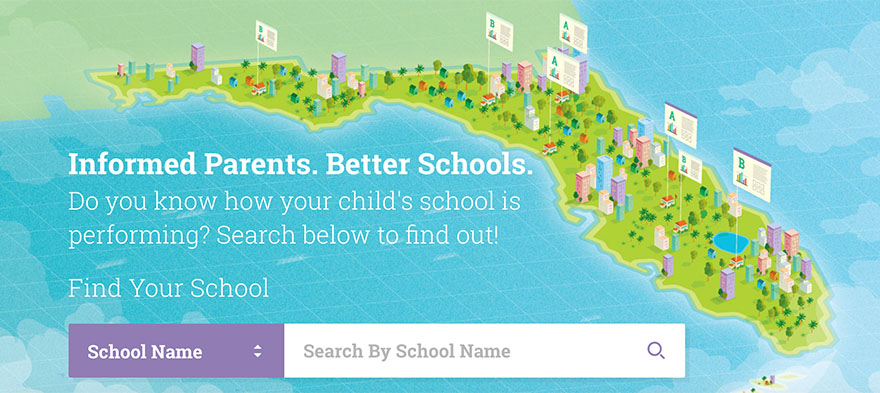
Do your kids go to a good school? “Good” depends on who you ask, of course, but if you’re interested in knowing how well a school is helping kids pass reading, math and science courses, or helping them grow academically, then that question just got easier to answer. Last week, Jeb Bush’s nonprofit foundation, ExcelinEd, released a new online tool that takes Florida Education Department data on school grades and puts it into a parent-friendly website that can be accessed from a mobile device or any computer. The move isn’t just to garner good PR with parents. It’s timely and potentially important for states. While the prototype site,  KnowyourFloridaschool.org, uses current Florida data, it was built with open-source code, and its creators are encouraging other states to take advantage of it. The federal education law, known as the Every Student Succeeds Act (ESSA), says states have to tell parents how schools are doing on a variety of measures. Guidelines from Washington say the information should be “ easily accessible and user friendly,” but few bureaucrats across the country have done a good job breaking down this information in a way that most people can use. Specifically, the law requires states to report information on school performance: How many students are performing on grade-level, how many are showing academic growth (even if they’re not quite to grade level), graduation rates and more. All of this information needs to be broken down by various subgroups of students too, like students with disabilities, students from low-income families, racial and ethnic minorities and English-language learners. Florida’s current system provides school grades, and offers a lot of the information about school performance and demographics on spreadsheets people could download from schoolgrades.fldoe.org, but it isn’t as easy to find, understand or compare. Anyone who wanted to find out how Hispanic students were doing, for example, would have to hunt through a half-dozen links to find the right spreadsheet. Knowyourfloridaschool.org puts it all together seamlessly:
  • Type the school name, district, or simply your address to see how schools near you are performing.
  • Select multiple schools and compare them side by side.
  • See the school’s overall grade, and individual factors that went into it.
  • Find colorful graphs breaking down student performance by school subject and subgroups like race, gender, income-level, and disability in the “Student Performance Details” tab.
  • Look up demographic information for the school under the “Student Characteristics” tab.
As Florida’s former Governor, Jeb Bush brought A-F school grades to the state in the ‘90s, before anybody else was doing it, and in the years that followed many other states adopted similar systems. Today, school grades are under attack by people who say letter grades are a potentially damning label that oversimplifies the work schools are doing. Opponents either ignore the information available to parents that leads into an overall grade, or they express concern that parents will ignore it.  Some states are considering abandoning or weakening their current A-F accountability systems. Supporters, on the other hand, like ExcelinEd’s CEO, Patricia Levesque, say school grades are “a vital tool to empower parents with school data and the information they need to engage proactively with school leaders on behalf of their child.” The truth lies somewhere in the middle. Some parents do just want to see the letter grade and nothing else. Studies show that other parents, particularly low-income parents, prioritize proximity, or the quality of the school’s athletic program over academics. Those parents who do place an emphasis on a school’s track record for helping kids succeed don’t always know where to find the information they need, or what to make of it when they do. Based on the organization’s press release, it’s clear that Bush’s organization hopes the easier the information is to grasp, the more parents and communities will start using it.
An original version of this post appeared on Faces of Education as Florida Parents (and Others, Potentially) Get Easier Access to School Grade Info.

Lane Wright

Lane Wright is Director of Communications and Advocacy for the National Council on Teacher Quality, and formerly served as Director of Strategic Growth for Education Post and brightbeam. Lane has more than 18 years of experience in strategic communications and education advocacy. He tells stories that help families understand how their schools are doing, how to make them better, and how policy plays a role.

Leave a Comment

The Feed

Explainers

  • EXPLAINED: What Are Standardized Tests and Why Do We Need Them?

    Ed Post Staff

    Few issues in education spark more tension and debate than standardized testing. Are they a tool for equity or a burden on students? A necessary check on school systems or a flawed measure of...

  • Explained: What Is the Federal Charter Schools Program?

    Ed Post Staff

    Charter schools are public schools with a purpose. Operating independently from traditional school districts, they're tuition-free, open to all students, and publicly funded—but with more flexibility...

  • A Leaky Educator Pipeline Loses Teachers of Color

    Ed Post Staff

    Despite the benefits of a diverse teaching force, prospective teachers of color fall out of our leaky preparation pipeline at every stage: preparation, hiring, induction, and retention. Here’s what...