
I have a vague memory of sitting on a little wooden potty chair in my grandparents’ living room. Green shag carpet beneath my feet. Positioned in front of a massive television, back when TVs looked more like furniture than flat screens.
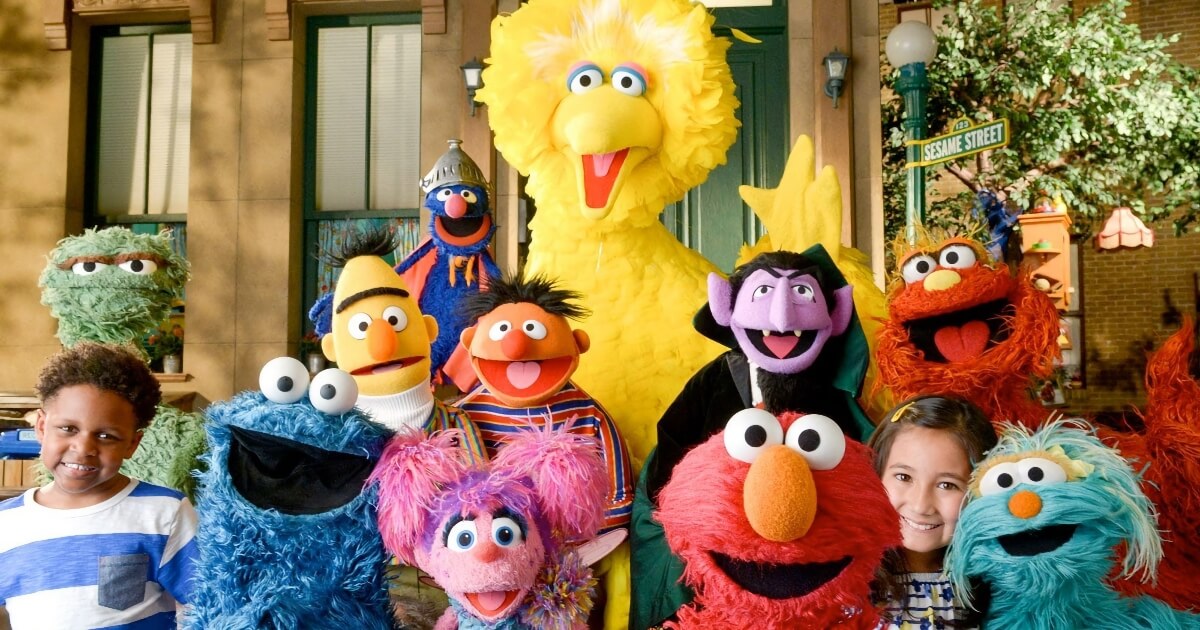
And there I met them: Kermit, Ernie and Bert, Big Bird, Oscar, The Count, and my favorite, Grover.
I couldn’t have known it was all a bait-and-switch. It was broccoli wrapped in candy colors. Education as entertainment —I ate it up.
This Monday was Sesame Street’s 56th birthday. The show premiered in 1969 and changed everything the nation thought about education, media, and what’s possible when you combine the two with genuine innovation and creativity.
Somewhere, there needs to be a statue in tribute to Jim Henson and his peerless literacy legacy.
While I was entertained by the personalities of my muppet friends, the animations, songs, and skits, the clever minds behind them all were creating a school in a new medium. A mass media play on preschool that could get information and developmental content to millions more children than America’s broken system of early childhood education could reach.
The genius of Sesame Street wasn’t that it taught letters and numbers. The genius was making learning irresistible by disguising it as joy.
Can you remember any Sesame Street episodes that didn’t induce smiles or laughter?
They didn’t just create educational content. They studied how kids paid attention. Tested segments. Brought in child development experts. Then hired Henson and his muppets to make it beautiful, funny, and unforgettable.
The result was a show that taught without feeling like teaching. It created a world unmistakably furnished just for kids of every stripe.
At my age now, it’s fuzzy what concepts I learned from the Street Gang. But I remember sing-songy snippets about letters, numbers, and grammar. “One of these things is not like the others.” “C is for cookie.” The Count counting everything. Grover demonstrated “near” and “far” by running until he collapsed.
I never forgot the impact.
I became a sustaining member of the Sesame Workshop a few years ago. As an education activist, I think we need to honor the bewildering creativity and pedagogical milestones left by huge contributors and accidental educators like Henson. He’s among my models. The heroes who left marks I look up to. New media, communications that lift society rather than drag it down. New ways to educate. Democratizing learning in the U.S., but also globally.
As I understand it, Henson didn’t set out to be an educator. He was a puppeteer, an artist who wanted to make people laugh. But when Cooney and Morrisett approached him, he saw the opportunity to do something bigger. He proved something essential. Education doesn’t have to be boring to be rigorous.
Learning isn’t just in classrooms. It’s what happens when you’re entertained, engaged, and curious. When someone meets you where you are and hands you something worth knowing in a way that makes you want more.
That’s the lesson for smartography.
Sesame Street’s impact is vast. A 2013 meta-analysis examined 24 studies conducted with over 10,000 children across 15 countries. Kids who watched were more prepared for school, had better vocabularies, and stronger number skills. The effect size held across experiments, quasi-experiments, and surveys. It was significant in both low-income and high-income countries. The effects were particularly strong among children from economically disadvantaged backgrounds.
The reach was staggering. In Bangladesh, nearly 7 million children aged 4-7 watched Sisimpur. In Indonesia, 7.5 million children aged 3-6 watched Jalan Sesama. In Egypt, nearly 12 million children aged 2-8 watched Alam Sim Sim. Even in India, where only 58% of children have access to television, over 20 million children were watching regularly.
Compare that to traditional interventions. Preschool enrollment in Bangladesh sits at roughly 10% of the relevant age group. Yet nearly half of children watched educational television daily.
Beyond data, there’s something more challenging to quantify. Millions of us grew up thinking learning was fun because muppets taught us it could be. The show made knowledge accessible without dumbing it down. It respected kids’ intelligence while meeting developmental needs. It taught complex concepts through simple stories. Empathy. Diversity. Conflict resolution. It modeled curiosity and showed that making mistakes is part of learning.
All while being wildly entertaining.
That’s the magic. Not choosing between rigor and joy. Finding where they meet.
What Sesame Street understood is that the medium matters. How you deliver knowledge shapes whether it sticks.
A lecture about letters is forgettable. A song performed by a blue furry monster who eats cookies is forever.
This matters for adults, too. Lifelong learning requires the same principles Sesame Street pioneered. Meet people where they are. Make it relevant. Make it engaging. Never talk down.
This is why I’m developing smartography alongside stupidology. If stupidology debugs our thinking and protects against manipulation, smartography builds intellectual capacity across our entire lives. It’s about creating conditions that make getting smarter irresistible. Shows. Systems. Communities.
We know how to do this. Sesame Street proved it possible. They took the medium everyone said was rotting kids’ brains and turned it into the most effective early learning intervention in history. They didn’t wait for the education system to fix itself. They built something new.
But we’re not systematically building what works. We have the technology. We have the research. We have examples proving it’s possible at scale. Yet we’re stuck debating incremental school reforms while the real opportunity sits unused. Creating new mediums, new systems, and new ways of making learning irresistible beyond the boundaries of traditional schooling.
The cognitive gains from Sesame Street were comparable to other early childhood interventions. But they reached exponentially more children. Educational television provided consistency of quality that traditional interventions couldn’t match. All children with viewing access received the same educational curricula, presented the same way.
We could build infrastructure that makes getting smarter accessible and joyful for people at every life stage. We just keep choosing not to.
Happy 56th birthday to Sesame Street. To Joan Ganz Cooney, Lloyd Morrisett, and Jim Henson. To everyone who believed education could be joyful, accessible, and transformative.
To the muppets who taught me letters and numbers and empathy and curiosity without me even knowing I was being taught.
And to the idea that we can still create new mediums, new systems, new ways of making learning irresistible for people at every life stage.
Because the opposite of all the writing I’ve been doing about the study of human “stupidity,” isn’t just avoiding mistakes or reasoning properly. For the individual learning, it’s building the capacity to keep learning, keep growing, keep getting smarter.
For education’s big thinkers and educators, it’s about amplifying your capacity to teach beyond classrooms and to ensure learning happens everywhere, all the time, with or without school.
That task is made easier by milestone examples like Sesame Street, which have no rivals when it comes to the creation of a wildly successful unSchool.
Perhaps that’s something for me to build on in future posts since some of y’all aren’t ready for Stupdiology. You’d rather I focus on a positive counterpoint. Let’s call it “Smartography” (Yes, I made it up. Is that surprising?).
Because all roads in education seem to lead to a complaint, but Sesame Street leads to learned people.
This post was originally published on Verbatim.