
This time of year, educators and school leaders often set goals for themselves. I hope making improvements to science education is on everyone’s list.
The Nation’s Report Card results out this month are deeply disappointing, especially for middle-school science teachers like me. Scores for eighth graders nationwide fell four points since 2019 on the National Assessment of Educational Progress, also known as the Nation’s Report Card.
Students lost ground in all content areas—physical, life, and earth and space sciences. Less than a third of eighth graders hit the NAEP Proficient mark. Nearly 40% are working below the NAEP Basic level, meaning, for example, they likely can’t identify a characteristic of mammals.
Like in other subjects, lower-performing students lost more ground than those working at higher levels. Unless addressed, this achievement gap will severely limit STEM opportunities for large percentages of students—both in school and in the workforce.
Science Content and Instruction Lack Cohesion
I work in a Defense Department, or DoDEA, school, where we have a shared curriculum aligned with rigorous science standards. Across the country, however, science content and instruction often lack cohesion. A RAND survey reveals that most K-12 teachers don’t use a curriculum as their primary instructional resource to teach science, and about a third rely on materials they create themselves. Classroom teachers typically don’t have the time to write core curriculum.
Survey data accompanying The Nation’s Report Card also found that fewer students regularly participate in inquiry-based scientific activities, such as coming up with research questions to explore how something works and running experiments to answer a scientific question. That explains a lot.
Inquiry-Based Lessons Boost Achievement and Engagement in Science
A common teacher saying is, “hands on, minds on.”
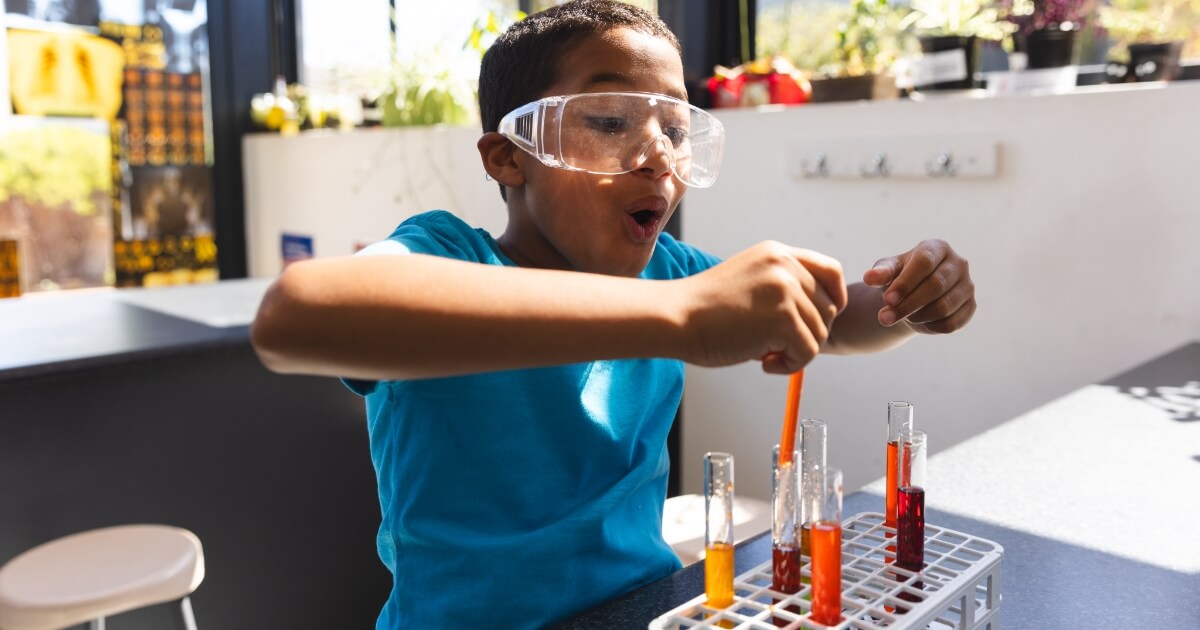
Kids need inquiry-based learning opportunities to build knowledge and skills in science, and research shows these approaches can boost achievement and engagement in middle school science classes.
I see my own students light up when we study forces and motion using the classic egg drop experiment, in which they build structures to prevent an egg from breaking when dropped, or when they design model buildings that can withstand an earthquake, something that’s particularly relevant here in Japan. They also love friendly competition when they work in groups to out-build and out-engineer their peers.
They say parents are a child’s first teacher, but I get some of my best ideas for hands-on science lessons from my daughter, Cheyenne, who teaches sixth grade in Sacramento Public Schools. She gets her students out on science-related field trips as often as she can. Recently, she took them outdoors to observe and examine the traits and adaptations of the local wildlife. Students identified animal tracks and hiked around a creek for a hands-on macro-invertebrate lesson in which the kids learned about the role these organisms play in their ecosystem. She also brings the outside world into her classroom, with help from the National Geographic Explorer Classroom program, in which scientists Zoom into classrooms to discuss topics such as planetary systems, mapping, and conservation.
Spending More Time On Science Boosts Achievement in Science, Math, and Literacy
Instructional time can also be a challenge. Research shows science tends to get less time during the day than other content areas. That needs to change. Spending time on science boosts science achievement but also supports literacy and math learning, areas that also need bolstering.
As teachers, we can extend student learning by striking a balance between classwork and homework. I’ve found science can be a great way to engage families in a child’s learning, more than just a student completing a written assignment. I recently asked my students to make ice cream at home, a fun way to learn about the properties of matter and heat transfer. Parents and siblings loved joining in and learning how salt plays a role in the process.
Teachers Need More Support to Teach Science Well
The latest NAEP scores also should prompt us to look at how to better support teachers. The RAND survey found that teachers get less professional development in science than in other core subjects. DoDEA teacher unions are tackling this by tapping subject matter experts to support professional learning in schools in Japan, Guam, and Korea. I serve in one of these roles and will focus on improving science engagement.
Stateside, and in non-DoDEA schools, education leaders and districts can also do this, sharing resources and professional learning opportunities across regions. In a recent survey, students said that one of the most important ways to help them stay motivated in STEM subjects is to have teachers who explain concepts well. However, for teachers to do that, they need to know the content well. Professional development and increased efforts to recruit teachers with strong science backgrounds can help.
The latest Nation’s Report Card serves as an urgent warning to policymakers and education leaders.
It’s vital that we prioritize science and give students the educational experiences they need in this critical subject.
If we fail to do this—given the growing number of problems that require scientific solutions—we’ll be doing great harm to our kids and to our country.