


May 14, 2018 12:00:00 AM
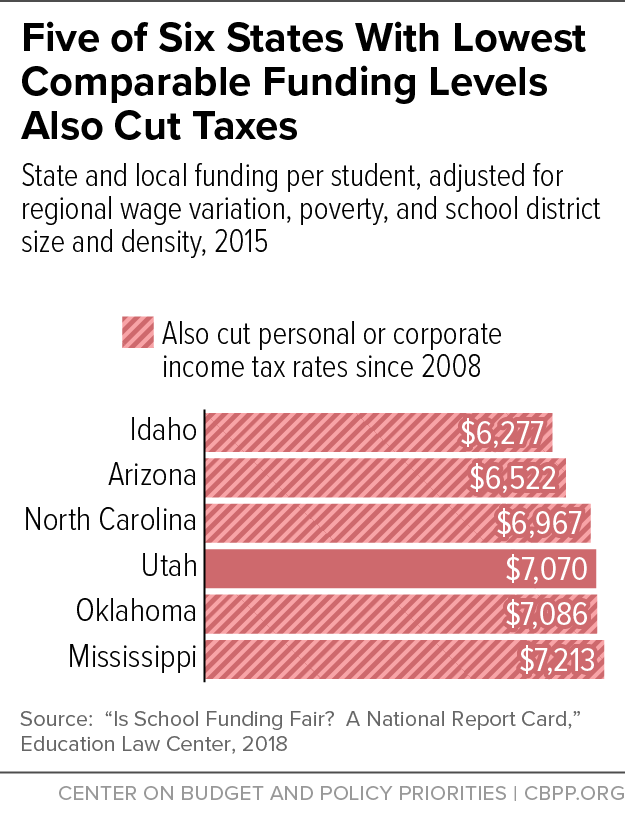 The revenue lost to tax cuts also made it much harder for the state to fund schools adequately. Only two states do a worse job in this area than North Carolina, according to an
analysis by Education Law Center and Rutgers University that adjusted for student poverty, regional wage variations and other factors that affect costs in different areas. In fact, all but one of the other states with the worst-funded school systems according to the Education Law Center report, including Arizona and Oklahoma, also cut income tax rates in recent years (see graph). Further, while most states have gradually restored the school funding they cut when the Great Recession hit in the 2007-2008 school year, North Carolina hasn’t come close. State “formula” funding for schools—the major form of state funding for public K-12 schools in North Carolina—is
down 7.9 percent per student since the Great Recession hit, after adjusting for inflation. Large state funding cuts have made improving teacher pay particularly challenging, since salaries and other compensation for teachers and other education workers comprise most K-12 education spending in North Carolina. [pullquote]Average teacher pay in North Carolina has
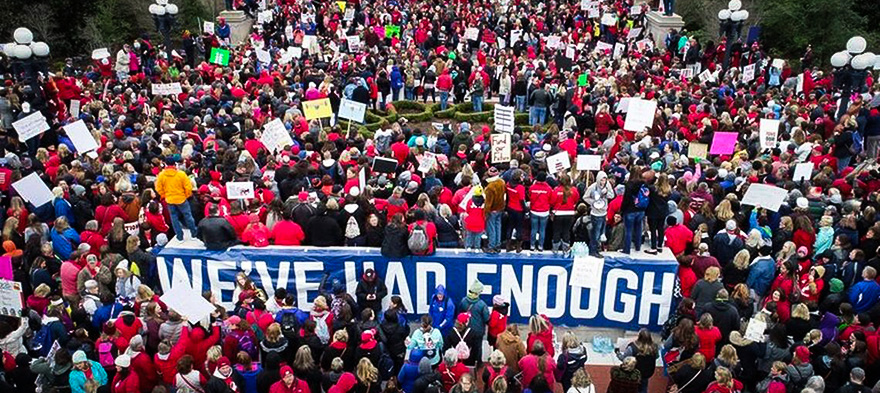
fallen 5 percent since 2010[/pullquote], after adjusting for inflation. While average teacher pay has shrunk in inflation-adjusted terms in most other states in recent years, the drop in North Carolina came on top of harsh, earlier cuts. Since 2000, average teacher pay in the state has fallen 12 percent, after adjusting for inflation, the third deepest cut in the nation. As lawmakers gather in Raleigh this week and hear from teachers around the state, they should focus on reversing the 2013 tax cuts—or, at the very least, put the brakes on further scheduled cuts.
As the North Carolina Budget & Tax Center notes, North Carolina will lose another $900 million or so a year in revenue from the cuts scheduled to take effect next January, which would see the corporate income tax rate fall to 2.5 percent and the personal income tax rate fall to 5.25 percent. These additional tax cuts would help put the state’s budget out of balance in future years, requiring budget cuts to K-12 education and other public services—exactly the opposite of what North Carolina needs to promote a brighter economic future.
The revenue lost to tax cuts also made it much harder for the state to fund schools adequately. Only two states do a worse job in this area than North Carolina, according to an
analysis by Education Law Center and Rutgers University that adjusted for student poverty, regional wage variations and other factors that affect costs in different areas. In fact, all but one of the other states with the worst-funded school systems according to the Education Law Center report, including Arizona and Oklahoma, also cut income tax rates in recent years (see graph). Further, while most states have gradually restored the school funding they cut when the Great Recession hit in the 2007-2008 school year, North Carolina hasn’t come close. State “formula” funding for schools—the major form of state funding for public K-12 schools in North Carolina—is
down 7.9 percent per student since the Great Recession hit, after adjusting for inflation. Large state funding cuts have made improving teacher pay particularly challenging, since salaries and other compensation for teachers and other education workers comprise most K-12 education spending in North Carolina. [pullquote]Average teacher pay in North Carolina has
fallen 5 percent since 2010[/pullquote], after adjusting for inflation. While average teacher pay has shrunk in inflation-adjusted terms in most other states in recent years, the drop in North Carolina came on top of harsh, earlier cuts. Since 2000, average teacher pay in the state has fallen 12 percent, after adjusting for inflation, the third deepest cut in the nation. As lawmakers gather in Raleigh this week and hear from teachers around the state, they should focus on reversing the 2013 tax cuts—or, at the very least, put the brakes on further scheduled cuts.
As the North Carolina Budget & Tax Center notes, North Carolina will lose another $900 million or so a year in revenue from the cuts scheduled to take effect next January, which would see the corporate income tax rate fall to 2.5 percent and the personal income tax rate fall to 5.25 percent. These additional tax cuts would help put the state’s budget out of balance in future years, requiring budget cuts to K-12 education and other public services—exactly the opposite of what North Carolina needs to promote a brighter economic future.

Leave a Comment