



Mar 5, 2018 12:00:00 AM
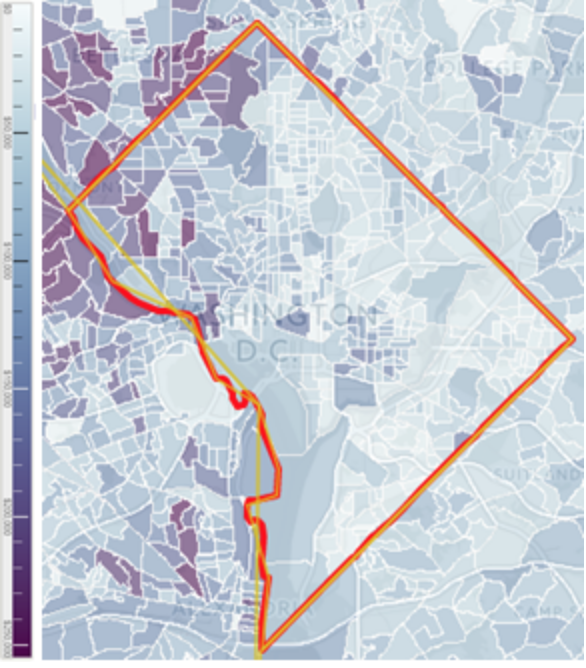 Yet, even when I consider this policy change as a solution in my current home of Washington, D.C., I’m lost as to whether this would work. The map above illustrates the
current level of income disparity across the District, with darker colors representing higher incomes. The distribution of income is too large to use as attendance boundary criteria, with a clear divide between the upper northwestern region and the rest of the District. D.C. Public Schools (DCPS) tries to remedy this by designating most of their schools as open enrollment, but priority is still given to neighborhood students. Although DCPS should be commended for its strong commitment to equity, there is still much work to be done, especially considering its most recent PARCC scores and the
disparities between racial groups that still exist.
Yet, even when I consider this policy change as a solution in my current home of Washington, D.C., I’m lost as to whether this would work. The map above illustrates the
current level of income disparity across the District, with darker colors representing higher incomes. The distribution of income is too large to use as attendance boundary criteria, with a clear divide between the upper northwestern region and the rest of the District. D.C. Public Schools (DCPS) tries to remedy this by designating most of their schools as open enrollment, but priority is still given to neighborhood students. Although DCPS should be commended for its strong commitment to equity, there is still much work to be done, especially considering its most recent PARCC scores and the
disparities between racial groups that still exist.

Leave a Comment