Sometimes no progress represents real progress, especially when you’re talking about an urban school district roiled by financial woes and a national exam that has become the best barometer of educational standing in recent decades. Chicago Public Schools (CPS) ranks in the middle of the pack when it comes to 27 major urban districts, according to 2017 results of the Nation’s Report Card released recently as part of the Trial Urban District Assessment. Chicago’s scores for math and reading, for both fourth- and eighth-graders, remained the same in 2017 compared to 2015. Additionally, the city saw no change in the percentage of students who scored at or above proficient—and at or above basic—for both subjects and both grade levels. Of course, there are still deep and intractable gaps between low-income and middle-income kids in Chicago and nationwide—and the gap between Black and White students remains high, although it did shrink slightly in Chicago in 2017, but not for the most promising reason— the scores of White students dropped from 2015 to 2017. There’s still plenty of room for improvement, as shown by the reading and math scores of the city’s fourth-grade low-income students, which are typical of other big cities and illustrate the still-looming achievement gap. 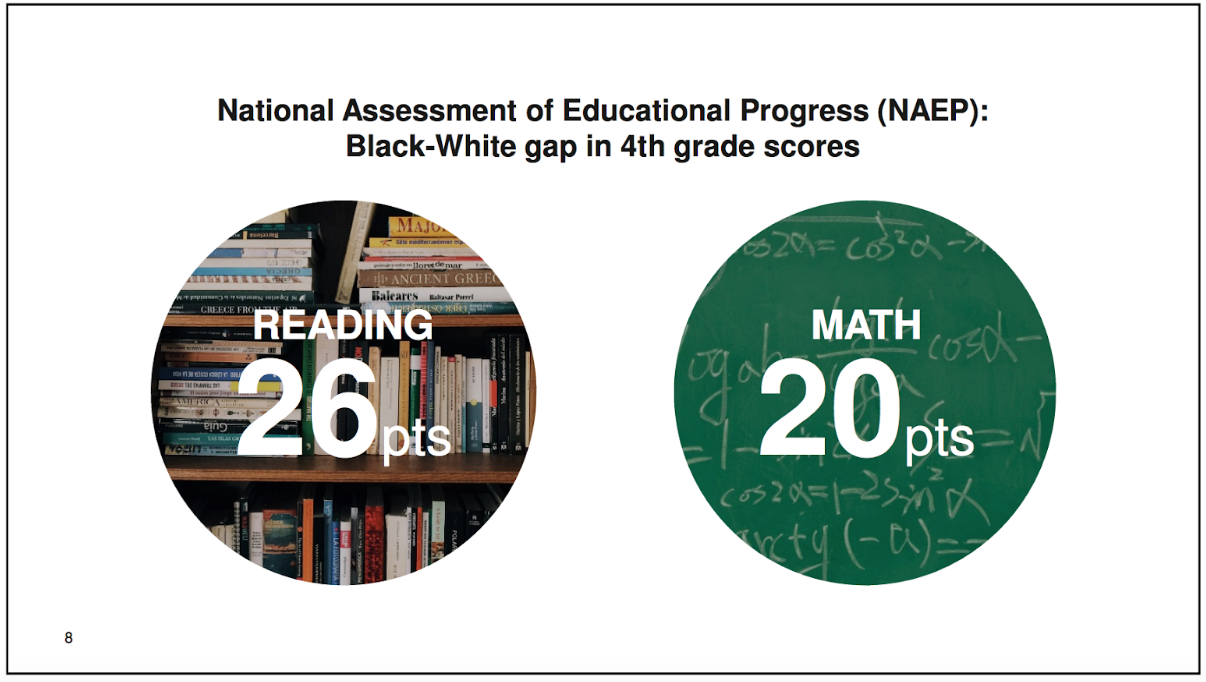 But given how tumultuous the last two years were in Chicago—the financial woes and the personnel upheaval—it’s a bit of shocker that CPS didn’t slide backwards on this exam. School leaders also predicted that the change in the test, from paper-and-pencil to all computer-based, would make it harder for kids and cause scores to dip. But that didn’t happen in CPS. “The fact that test scores are flat is actually good news,” said Elaine Allensworth, director of the University of Chicago Consortium on School Research, which has been studying Chicago’s school reforms and collecting data on the district since 1990. “Given all the disruptions and the financial trouble, the fact it hasn’t lost ground is actually pretty good.” Allensworth suggested that the district was able to keep scores stable by keeping its focus on a handful of key improvements during tough times, including preserving a robust teacher evaluation program, better training for math instruction, staying the course on Common Core learning standards, and continuing to use data strategically. It wasn’t too long ago that Chicago was among the worst-performing urban districts in the nation. Now Chicago’s average scores are indistinguishable from the average of all big districts, many of which are better funded and have far fewer students living in low-income families. When the nation first started measuring big-city educational progress in 2003, only a tenth of Chicago’s fourth- and eighth-graders scored as proficient in mathematics, which is considered a high bar and an important predictor of college readiness. Fourteen years later, that percentage has tripled. The number of fourth- and eighth-graders CPS students scoring at or above basic in math has also climbed significantly during this time. Here’s another piece of good news buried in these results that bodes well for the district’s sustained improvement, especially among a group of kids who struggle with the largest achievement gaps nationwide—students who qualify for free and reduced-price lunch. If you look at how Chicago’s low income eighth-graders score on math, their average score is two points higher than the national average for all low-income students—and in reading, Chicago‘s eighth-graders match the national average for low-income students. This is huge, because it means Chicago is making meaningful and authentic strides with a vulnerable group of learners and keeping pace with higher performing districts in the suburbs, rural areas and other cities. In fact the only big city that does better with its low income eighth-graders is Boston. All in all, the results on the Nation’s Report Card suggest that Chicago’s steady progress is authentic, and the district needs to stay the course on common-sense reforms that have moved the needle so dramatically in the last decade.
Chicago’s Students Are Standing Still on Test Scores But That’s Good News