
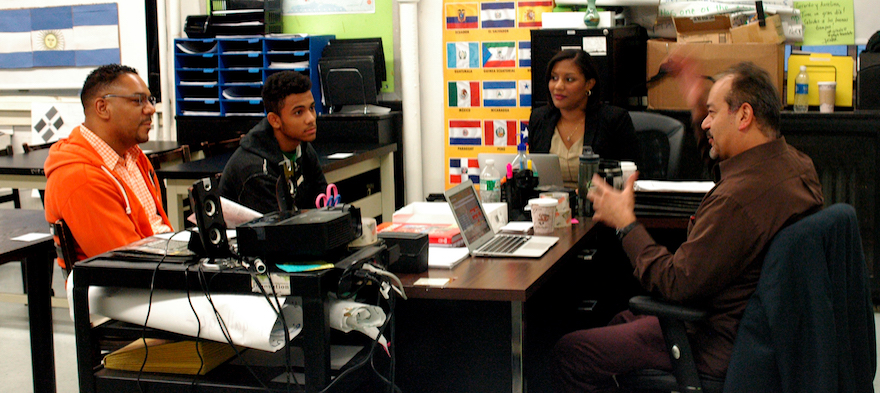
This New Report Shows How Parents and Teachers Can Work Together

Feb 14, 2019 12:00:00 AM

by

As a parent, I want my children to love learning and succeed academically. But even though I work full-time in education, I don’t always feel confident that I know the best way to support my kids’ learning. I find it challenging to sort through all the information the school sends home, and to triangulate that information with my own observations. And with everybody’s busy schedules, finding enough time to take action is always a struggle. What’s true in my house is surely true for others, which is why [pullquote position="right"]I’ve become interested in how to help parents get the information they need to support learning at home.[/pullquote] Learning Heroes, a non-profit that equips and informs parents so they can best advocate for their child’s academic success, recently released Parents 2018: Going Beyond Good Grades, a national report based on research conducted among school leaders, teachers, parents and children. Combing through this research, as well as the reports from the previous two years, there are some findings I believe should change the way we think about parent and family engagement:
  1. Most parents have ambitious educational goals for their children, with 80 percent of parents saying that it’s absolutely essential or very important for their child to go to college and receive a two-year or four-year degree.
  2. Parents also feel a strong sense of individual responsibility for their children’s education. In fact, 43 percent of parents said that they have the greatest responsibility for their child’s success in school, as compared to only 12 percent of parents who said that their child’s teacher has the greatest responsibility.
  3. And yet, the survey results indicate that one of teachers’ strongest concerns is about the level of academic support that parents provide for their children.
Here then is the situation we appear to be in: parents have ambitious goals, and they feel responsible for helping their children attain them, yet it seems that teachers aren’t seeing strong levels of academic support from parents.

Why the Disconnect?

For one thing, many parents who would like to support their children’s learning might not know the best way to do so. More on that in a moment, but the research reveals that there’s an additional factor potentially in play: Some parents might be less involved because they overestimate their children’s level of achievement, as a result of unclear or misleading information about their children’s proficiency. Indeed, Parents 2018 suggests that parents today might be taking too much comfort in their children’s report card grades. On the one hand, parents in the survey reported that their children’s report card grades are the most important information they use to know how their child is doing academically. On the other hand, many teachers reported that their grading takes factors into account other than the absolute level of performance—including student effort, class participation and improvement over time. Some teachers also reported a reluctance to award low grades because of pressures from administrators, parents or even themselves. To have an accurate sense of their children’s achievement, Parents 2018 recommends that parents look at several sources of information: report card grades, state test scores, assignments or quizzes that teachers send home with comments, the teacher’s feedback during parent-teacher conferences and input from the student. [pullquote]What subjects are your child passionate about, worried about or feeling in command of?[/pullquote] Thinking about my own parenting, I have to admit that putting together such a complete picture sounds daunting. So a good place to start is to get a gut check on how well your child has learned foundational skills needed for success in school. I was therefore excited to collaborate with Learning Heroes to help develop the Readiness Check a digital tool that includes quick, interactive questions that can help you see how your child handles important grade-level math and reading content. To serve our students’ best interests, we need more meaningful and objective discussions to occur between parents and teachers. Parents 2018 gives us reason to think that “closing the disconnect between what parents believe about their child’s performance and whether their child is actually meeting grade-level expectations is doable.” However, it will require concerted action on the part of school leaders, teachers, and parents.

Jason Zimba

Jason Zimba is a Founding Partner of Student Achievement Partners and was a lead writer of the Common Core State Standards for Mathematics.

Leave a Comment

The Feed

Explainers

  • EXPLAINED: What Are Standardized Tests and Why Do We Need Them?

    Ed Post Staff

    Few issues in education spark more tension and debate than standardized testing. Are they a tool for equity or a burden on students? A necessary check on school systems or a flawed measure of...

  • Explained: What Is the Federal Charter Schools Program?

    Ed Post Staff

    Charter schools are public schools with a purpose. Operating independently from traditional school districts, they're tuition-free, open to all students, and publicly funded—but with more flexibility...

  • A Leaky Educator Pipeline Loses Teachers of Color

    Ed Post Staff

    Despite the benefits of a diverse teaching force, prospective teachers of color fall out of our leaky preparation pipeline at every stage: preparation, hiring, induction, and retention. Here’s what...