
Few issues in education spark more tension and debate than standardized testing. Are they a tool for equity or a burden on students? A necessary check on school systems or a flawed measure of learning? To understand what’s at stake, we first have to ask: what are standardized tests, what are they used for, and why do they play such a significant role in our schools?
What Is Standardized Testing?
A test is standardized when all the students taking it have to respond to the same set of carefully selected questions. This allows people who look at the results to make comparisons among groups of students. Questions on these tests tend to be multiple-choice or true-false because that raises the chances that results are fair and objective, with less possibility for bias or favoritism in scoring the answers.
So… why do we have standardized tests? We need a clear, consistent way to understand how well students learn across classrooms, districts, and states. When used as intended, these tests help educators spot gaps and guide instruction toward the best results for all students. Without standardized testing, it’s harder to know what’s working and what’s not or how to improve.
Why Do Students Have to Take So Many Standardized Tests?
Learning is complex, and so are the systems that support it. When used thoughtfully, these tests can reveal where students need more support and how schools can improve. And because every child deserves a fair shot at an excellent education, we need ways to measure whether that promise is being kept.
Standardized testing is woven into many milestones in a student’s life, from early childhood through graduate school. Some of the most common examples include:
- Kindergarten readiness tests are required in about half of the U.S. states to assess early developmental and academic skills.
- Statewide annual assessments are mandated by federal law in grades 3–8 and, once in high school, typically in reading and math.
- College admissions tests like the ACT and SAT are still used. However, many colleges remain test-optional or test-blind, while others are starting to reinstate testing requirements in an effort to refine admissions and improve outcomes.
- Graduate entrance exams include the GRE for many graduate programs, the LSAT for law school, the MCAT for medical school, and other field-specific assessments
- International assessments such as the Programme for International Student Assessment (PISA) compare academic performance across more than 80 countries. If you’re curious—in the most recent results released in December 2023, the U.S. ranked 6th in reading and 28th in math among OECD countries.
However, there can be too much of a good thing—including too many tests. That’s because not every test serves the same purpose.
- A teacher might give a social studies quiz to check whether students understood a unit, helping them decide if they need to reteach something.
- A principal might test an entire grade level if students have been underperforming in math, to see if the curriculum or teacher support needs adjusting.
- Some school districts use standardized diagnostic tests multiple times a year—like NWEA’s MAP or Curriculum Associates’ i-Ready—to monitor student progress more closely.
In addition, federal law requires states to test students once a year in reading and math from grades 3–8, and once in high school. Federal law also mandates that states administer science assessments at least once in each of three grade spans: grades 3-5, 6-9, and 10-12. Some states satisfy these mandates, and others choose to go beyond what is required. Even if it’s essential, that doesn’t mean it isn’t also a lot.
Why Is the Federal Government Involved in Standardized Tests?
While America has some outstanding schools, we’ve struggled for a long time to raise achievement levels. In 1983, a bipartisan group of educators and officials wrote a report called “A Nation at Risk” that remarked, “If an unfriendly foreign power had attempted to impose on America the mediocre educational performance that exists today, we might well have viewed it as an act of war.”
Another standardized test given to representative groups of students (called the National Assessment of Educational Progress or the “Nation’s Report Card”) finds that two-thirds of children are not proficient readers.
America’s lagging status behind other first-world countries prompted the federal government to start mandating standardized tests in order to improve teaching and learning. A 1965 law called the Elementary and Secondary Education Act (ESEA) aimed to close opportunity gaps by providing additional funding for schools serving disadvantaged students. That law was reauthorized in 2002 as the No Child Left Behind Act (NCLB), which made standardized testing a core requirement for receiving federal education funds.
To qualify for that funding, states had to meet several new requirements:
- Annually test students in reading and math from grades 3–8, and once in high school.
- Disaggregate and report results by student subgroup, including students with disabilities, English-language learners, and low-income students.
- Hold schools accountable for helping all groups reach a benchmark called Adequate Yearly Progress (AYP).
- Intervene in schools that repeatedly failed to meet AYP, with actions ranging from additional support to school restructuring.
The law’s ultimate goal was that every student in the country would reach proficiency in reading and math by 2014—an ambitious target that quickly became one of the most debated elements of NCLB.
Why Are Standardized Tests So Controversial?
Standardized tests weren’t always controversial. But that changed when the federal government began using them to hold schools accountable. Around the same time, test results started revealing just how wide the gaps were between groups of students.
Many point to the No Child Left Behind era as the turning point. Suddenly, there was hard data showing that students of color were being left behind while their white peers moved ahead. That kind of transparency was uncomfortable, even painful, but it forced educators and the public to confront long-ignored inequities.
In response, we started taking student achievement—and the gaps in achievement between rich and poor kids, Black and white kids–more seriously. Instead of just filing results away, states began using the test results to evaluate the quality of schools, districts, state departments of education, and even teachers. This led to a series of questions:
- Why is this school turning out kids who struggle with math, while this other school’s students are math wizards?
- Are the textbooks at fault?
- Is it the principal?
- Is one school’s support for teachers better than the other school’s?
- Does one school have more homeless students or more students with disabilities or more English-language learners?
An example of the overly intrusive nature of NCLB was the absurdly ambitious goal of 100% proficiency by the 2013-2014 school year. In response, states lowered standards and made tests easier to pass so they would still receive federal funding. It also placed unrealistic demands on schools serving high-needs communities, and led to what many educators described as a toxic culture of “drill and kill” test-prep that took much of the joy out of school and learning.
For these reasons and more, in 2015, the law was reauthorized again, and No Child Left Behind became the Every Student S쳮ds Act (ESSA). The new law pared back the federal role in education by removing rigid annual benchmarks and giving states more control over how to measure school performance and drive improvement. Key changes under ESSA included:
- Eliminating Adequate Yearly Progress (AYP): States no longer had to meet federally mandated proficiency targets each year.
- Allowing states to design their own accountability systems: States could choose how to rate schools and identify those in need of support.
- Broadening measures of school quality: Beyond test scores, states could include factors like student engagement, graduation rates, and school climate.
- Reducing federal consequences: The law shifted away from punitive measures for underperforming schools and emphasized local solutions.
But even with greater flexibility, states are still required to share test results at the school and district level. The ultimate goal is transparency. With that information, we have a better chance of raising achievement levels across the country, especially for students who have historically been underserved.
Are Standardized Tests Racist?
America is beset by structural inequities, and one of the most dangerous and pervasive inequities is racism, which leaks into all aspects of life, from poorly maintained homes to sub-par medical carehealth disparities to food insecurity, to fewer resources for schools that serve students of color.
In addition to racism, there are other ways tests can be biased. There was a famous example in the 1990s when an SAT question asked for the best analogy between “runner” and “marathon.” The answer was “oarsman” and “regatta,” vocabulary that might only be familiar to wealthy teenagers.
But standardized tests can also be a way to overcome inherent bias. When teacher perceptions are the sole criterion for student access into gifted and talented programs, Black and brown students can be overlooked. Research shows that when standardized testing is used instead, more students of color are selected for accelerated learning.
Yet, standardized tests can still perpetuate racial inequity and systemic racial bias. Even today, students of color often face testing environments that don’t account for cultural, linguistic, or economic differences. A 2021 report from The Education Trust highlighted how Black and Latino students continue to score lower on national assessments—not because they lacked ability, but because they often attend schools with fewer available resources.
In New York City, admissions to specialized high schools like Stuyvesant are based entirely on a single exam, the Specialized High Schools Admissions Test. Critics argue that this approach favors students with access to costly test prep and disadvantages those from underrepresented backgrounds. In 2024, only 10 Black students received offers to Stuyvesant out of 744, reflecting ongoing concerns about racial equity in the admissions process.
This is why testing must be continually questioned and improved. Without intentional design and oversight, assessments that claim to be objective can reinforce the very inequities they’re supposed to help fix. Data can be powerful, but only if we understand what it’s really telling us and who it’s leaving behind.
What Do Standardized Tests Have to Do With Civil Rights?
Civil rights have long focused on issues of equity and equality. In the world of education, equity means there are systems in place to ensure that every child has an equal chance for success, regardless of their family income or the color of their skin.
There are many ways to see that these aspirations remain unrealized. But standardized test results are one of the most precise and most compelling indicators that civil rights advocates can use to show the glaring inequities in our current education system.
One example: A report by brightbeam found that in San Francisco, 70% of white students are proficient in math, compared to only 12% of Black students, a 58-point gap. This pattern—white students vastly outperforming Black students—is rampant in many parts of the country and underscores America’s challenge of raising achievement and infusing equity into our schools.
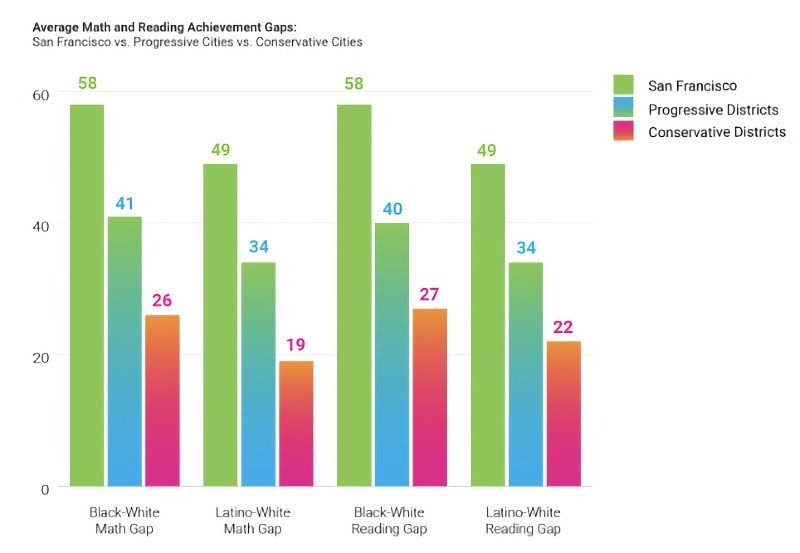
Standardized assessments help us narrow these vast disparities. They provide a clear way to measure how well our school systems serve kids most at risk.
This practice is right in line with the goals of the civil rights movement: to give all students equal educational opportunities and protection under the law, regardless of race or religion or income level. That’s why everyone from this teacher in Kentucky to Michelle Obama to Presidents Bush, Obama, and Trump call education the most important civil rights issue of our time.
Why Does the Federal Government Want Us to Test Every Child? Can’t We Just Test a Sample of Kids to See How a School District Is Doing?
We already do that through the “Nation’s Report Card,” which is given every other year to a sample of students in each state. It’s very useful! However, kids not tested by NAEP can fall through the cracks, and NAEP doesn’t provide the detailed information on an individual student’s proficiency available from more focused and inclusive tests.
Importantly, NAEP has no consequences for poor performance. It is meant to be a dipstick on the overall academic health of our country, state by state.
So how do we make sure states and districts actually work to improve the education they provide for underserved students? That’s where the federal government comes in. After all, our current national education law is called the “Every Student S쳮ds Act,” not the “Some Students S쳮d Act.” According to this law, if a state has too many students who aren’t meeting expectations in math or reading, then the federal government requires that state to identify districts, schools, and particular groups of students who need more support.
What Impact Did the COVID-19 Pandemic Have on Standardized Testing?
Many people agree that forcing kids to take tests during a plague-ridden year would be pointless and even cruel. Indeed, early in the pandemic, the Trump administration allowed states to waive all spring standardized tests for 2020.
The following year, many expected the Biden Administration to do the same thing, since large numbers of students were still learning remotely and schools had struggled all year to keep pace with learning. However, the Biden administration heeded the concerns of civil rights and educational justice groups, requiring that states continue testing, precisely because it was such a challenging year and so many children would have fallen behind.
However, states received flexibility in how and who they tested in 2021, so in truth, two years of data will be lost. This undoubtedly creates significant challenges for districts attempting to assess the effectiveness of their schools and curricula, and removes a crucial tool from the civil rights sector’s advocacy toolkit.
What Are the Opportunities for Activism?
UNDERSTAND the Tests Kids Are Taking and Why
In order to advocate effectively, you must understand the purpose of particular tests and how your school will use the results. Is it to drive instruction? Is it to measure state trends? Is it to fulfill federal regulations? The more you understand, the more equipped you are to stand up for the rights of children everywhere.
SHARE the Message That Standardized Testing Helps Uphold Civil Rights
Even if you are unconcerned about your own child’s progress, remember that without standardized testing, we wouldn’t be able to measure the proficiency gaps that highlight vast inequities within our public education system. Our schools are failing to justly serve large groups of children; in this sense, supporting standardized testing is part of the work of ensuring child justice. Undertake initiatives to raise your community’s comfort level with testing and their understanding of its powerful role in promoting educational equity.
PUSH Your State, District, or School to Make Standardized Testing Better
Current standardized tests, while vital for improving learning gaps, are stuck in the Stone Age. In order to minimize the time and money spent on assessments, state education systems need to invest in innovating our testing infrastructure. The technology is there to automatically grade essay questions, but we don’t use it. The technology is there to customize test questions to individual students’ level of proficiency, but we don’t use it. The technology is there to turn around test results within 24 hours, but we don’t use it.
Activists can demand that their state leaders invest in innovation to make tests less stressful and more useful for students, teachers, parents, schools, and states.